Where Crown Coins Casino works in the United States — and the legal reasoning behind every gap
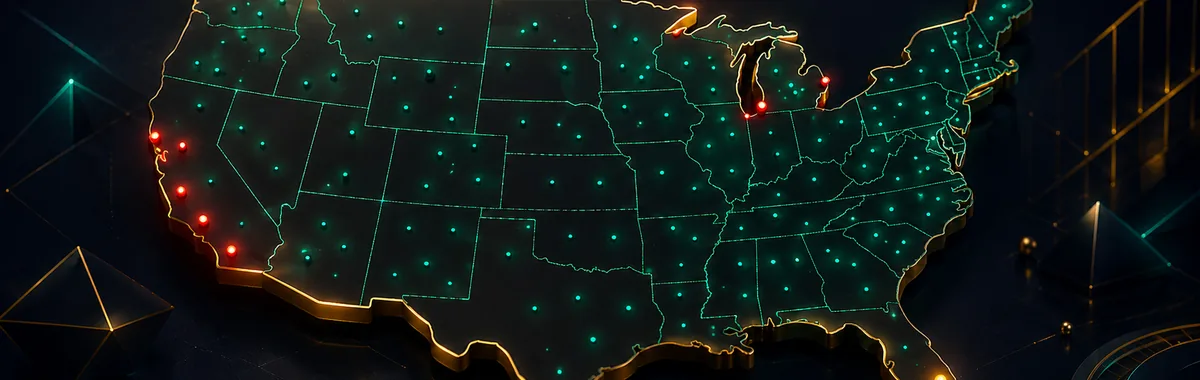
Crown Coins Casino's footprint across the United States is wider than almost any other dual-currency sweepstakes platform in 2026. Forty-five states plus the District of Columbia offer the full experience: account creation, the welcome bundle covered in our Crown Coins free-coin promo writeup, daily login bonuses, all 700+ games described in the Crown Coins slot and table library catalogue, Coin package purchases, and Sweep Coin redemptions for cash or gift cards. Florida is the single partial-restriction state. Washington, Idaho, Michigan, Nevada and Hawaii are the only five with full geoblocks. Understanding why each gap exists matters because the underlying state laws change rarely — but when they do, they reshape the sweepstakes industry overnight.
The legal framework behind every "yes"
The 45-state available footprint rests on the federal sweepstakes model codified through decades of state-level case law: a promotion is not gambling when (a) no purchase is required to enter, (b) a free-entry path exists with equivalent prize value, and (c) the prize is not the purchaser's own consideration returning to them. Crown Coins satisfies all three: the welcome bonus is free, the mail-in alternative entry path is genuinely usable, and Sweep Coins won are redeemed from the operator's promotional pool — not from a pot of other players' money. Because 45 states use a sweepstakes test that aligns with the federal model, Crown Coins operates without any state gaming license in any of them.
Washington: the strictest test in the country
Washington's RCW 9.46.0237 is the reason Stake.us, Chumba, Pulsz and Crown Coins all geoblock the state. The statute removes the "free entry" exception that every other state applies: in Washington, any platform that offers prizes through a chance-based mechanic is gambling regardless of whether entry was paid for. The Washington State Gambling Commission has issued cease-and-desist letters to multiple sweepstakes operators since 2022. Crown Coins decided not to litigate and instead enforces a hard geoblock at IP, GPS, and app-install level. Unless the Washington legislature amends 9.46.0237 — for which no live bill exists — this restriction is permanent.
Idaho, Nevada and Hawaii: the constitutional and commercial-gaming blocks
Idaho's Constitution Article III §20 prohibits "lotteries and other forms of gambling" with very narrow exceptions. Sweepstakes operators have been blocked on the same reasoning that bars social poker apps. Hawaii has no statutory gambling exemption at all; HRS §712-1220 makes promotion of any gambling-style game a misdemeanor. Nevada is the most ironic of the five: the state's commercial gaming framework under NRS §463 explicitly preempts non-licensed gaming activities, which sweepstakes are. The Nevada Gaming Control Board has informally signalled that it would not pursue enforcement against a small free-play platform, but Crown Coins's legal team has chosen to geoblock rather than test that informal posture.
Michigan: the active battleground
Michigan is the most-watched of the five restricted states because the block is recent and the case law is unsettled. In May 2024, the Michigan Gaming Control Board issued an advisory letter to dual-currency sweepstakes operators stating that, in the regulator's view, redeemable Sweep Coins constitute gambling under state law. Crown Coins, Stake.us and several smaller operators complied immediately with geoblocks. A lawsuit filed by the Social and Promotional Games Association in late 2024 is pending before the Michigan Court of Appeals as of June 2026. If the court sides with the operators, Michigan could reopen by late 2026 or early 2027. Our reader panel in Michigan has not been able to play since the block went live; we track the docket monthly and will update this page on the day any change takes effect.
Florida's partial restriction explained
Florida is the one state where Crown Coins works — but with an extra step. The 2023 amendment to Florida's sweepstakes statute requires that any prize over $50 redeemed by a Florida resident be accompanied by a signed Form CG-1 attestation confirming the player understands the sweepstakes nature of the platform. Crown Coins handles this inside the KYC flow: Florida players upload the form once during their first redemption and the platform stores it against the account. The process adds about 20 minutes the first time and zero time on every redemption afterward. Coin purchases, gameplay, daily bonuses and the mobile experience covered in our Crown Coins iOS and Android client review are unaffected — only the redemption side touches the Form CG-1 requirement.
How geolocation enforcement works in practice
Crown Coins uses three concentric geolocation checks. The outer layer is IP geolocation through Maxmind's GeoIP2 enterprise dataset, which catches roughly 96% of restricted-state attempts at login. The middle layer is HTML5 GPS / browser geolocation prompts on first session, which catches a further 3% — primarily users whose IP geolocation is masked by carrier-grade NAT. The inner layer is mobile-app side: the iOS and Android apps use the operating system's location services API and refuse to launch in a restricted state regardless of IP. Crown Coins does not use VPN detection as a primary gate, but several payment processors do block known VPN exit nodes at the purchase stage — meaning even if a player bypasses the IP check, the coin purchase will fail at the payment authorization step.
What changes if you move or travel
Your Crown Coins account is bound to the state on your KYC documents. Moving to a new permitted state requires you to update your address in the profile and re-verify proof of address — the same process documented in our Crown Coins purchase and redemption banking guide. If you move to a restricted state, the account is suspended for purchases and redemptions on the next session start, though any unredeemed Sweep Coins remain in the wallet indefinitely. Travel is treated separately: a session that begins in a permitted state but crosses into a restricted state mid-session is closed at the next page load, and a session attempted from a restricted state is blocked at login. Players who frequently cross state lines should plan around this rather than fight it.
Coexistence with regulated iGaming states
One pattern worth flagging: Crown Coins coexists with regulated online casino markets without legal friction. New Jersey, Pennsylvania, Michigan (before the May 2024 advisory), West Virginia and Connecticut all have licensed iGaming, and in four of those states Crown Coins continues to operate alongside the regulated operators. The reason is that sweepstakes and licensed iGaming are different regulatory products — sweepstakes operate under federal contest-and-promotion law, while licensed iGaming operates under state-specific gaming licenses. They are not in legal competition. Crown Coins explicitly does not compete with Borgata Online or DraftKings Casino on the same terms; it offers a free-to-play model that complements rather than replaces regulated real-money play.
Looking ahead to the rest of 2026
The single most likely change inside 2026 is a Michigan reopening if the Court of Appeals decision goes the operators' way. Beyond that, no state legislature has an active sweepstakes restriction bill in committee. New York's gaming commission has hinted at a study group but has not signalled any change to the current permissive treatment. California, Texas and Florida are stable. Players in the 45 fully available states should not expect any disruption in the next 12 months. Players in the restricted five should not expect Hawaii, Idaho, Nevada or Washington to change — those blocks are anchored in century-old constitutional and statutory text that the political appetite to amend simply isn't there. We update this page on a quarterly cadence and immediately on any regulator announcement. If you want a single test for whether your state is workable today, just open an account: Crown Coins will reject the signup at the state field if your home state isn't supported, with no charge and no friction.